
The Lake County Inmate Population
Almost everyone in the Lake County inmate population sits in one building. The Lake County Detention Center in downtown Tavares is the county jail, and the Lake County Sheriff's Office runs it. The Sheriff's Corrections Operations page lists the jail as a 960-bed facility built in 1992 with an average daily population of 828 inmates. The same page reports 9,169 bookings during 2019. So the count you see on any given day is a slice of a much larger yearly flow of people in and out.
The Lake County Sheriff's Office homepage gives the local context for that work. The agency is led by Sheriff Peyton C. Grinnell, and it describes the Detention Center as holding misdemeanor and felony inmates, both male and female, plus juveniles held under county jurisdiction.
The Sheriff's main public page shows the office, the jail contact block, and the inmate search link in one place. The Lake County Sheriff's Office homepage is the front door for jail and inmate questions.
That homepage is also where the office posts the address, jail phone line, and administration hours that families use when the roster does not answer their question.
Two numbers move the Lake County inmate population up and down. Arrests and bond decisions push it up. Releases, dismissals, and transfers to state prison pull it down. Because of that churn, a name can drop off the roster within hours, and a sentenced person can leave county custody entirely for the state system.
Lake County Inmate Population Statistics
The headline figures come from two official sources. The Sheriff's Corrections Operations page gives the local capacity and average daily population. The Florida Department of Corrections gives a current, statewide-comparable count. Each figure below is tied to its source and year so you can check it.
The Florida Department of Corrections collects monthly jail numbers from every county under state law. Its July 2024 County Detention Facilities report puts the Lake County jail average daily population at 824 and the countywide incarceration rate at 2.0 per 1,000 residents. The Sheriff's own page reports a slightly different snapshot tied to 2019.
| Measure | Figure | Source / Year |
|---|---|---|
| Average daily population | 824 | FDC County Detention Facilities report, July 2024 |
| Average daily population | 828 | LCSO Corrections Operations page (tied to 2019 bookings) |
| Rated / bed capacity | 960 | LCSO Corrections Operations page; 2019 LCSO medical RFP |
| Bookings in 2019 | 9,169 | LCSO Corrections Operations page |
| Countywide incarceration rate | 2.0 per 1,000 | FDC report, July 2024 |
| Share of statewide county-jail population | 1.47% | FDC report, July 2024 |
You can see how the Sheriff frames these numbers on the source page itself. The LCSO Corrections Operations overview sets out the capacity, staffing, and accreditation behind the jail.
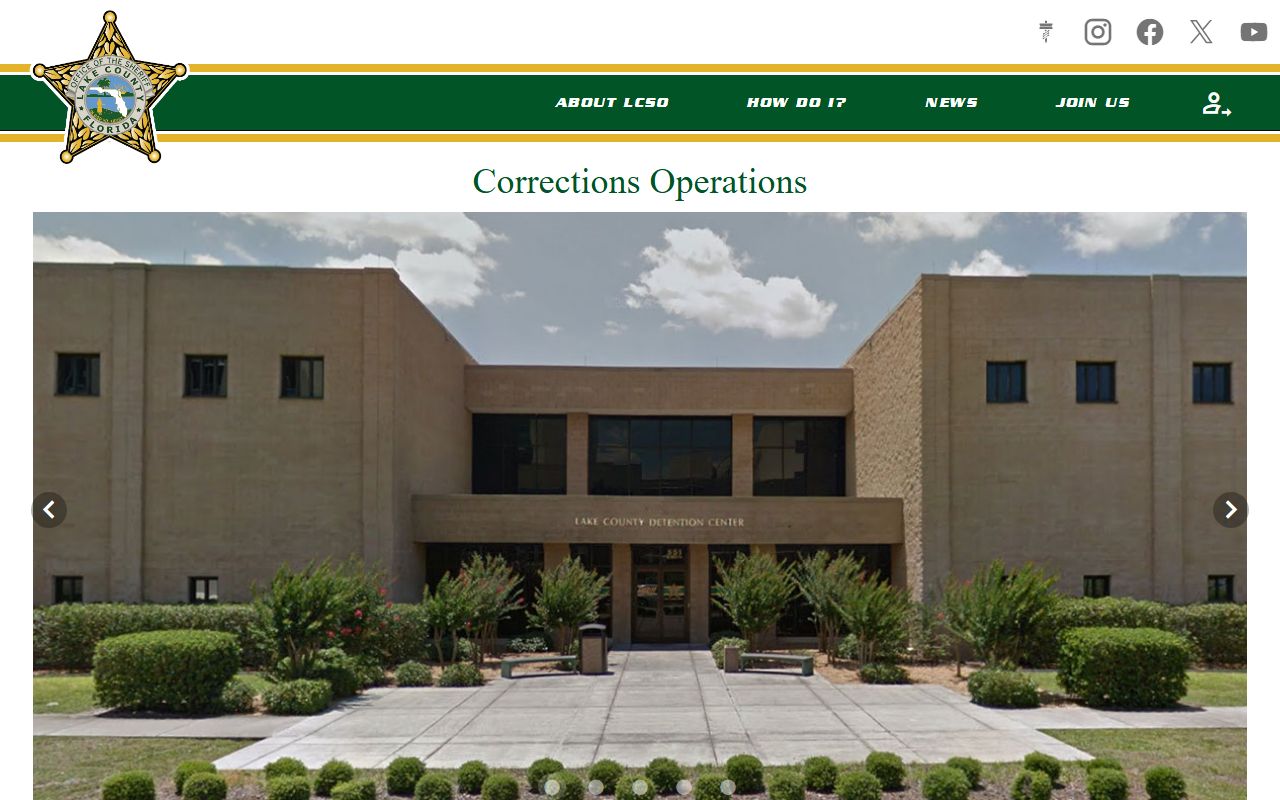
That page also notes the jail employs 239 people, with 179 sworn and 60 non-sworn staff, which is the workforce behind the daily count.
Lake County Inmate Population Trends
The Lake County inmate population has held fairly steady across the official snapshots that exist. The Florida Legislature's Office of Economic and Demographic Research reported a June 2020 jail average of 740. The Sheriff's page lists 828 tied to 2019, the 2019 jail medical contract estimated about 850, and the state's July 2024 report shows 824. No single official dashboard tracks the count day by day, so these dated figures are the best public markers.
| Year | Average Daily Population | Notes |
|---|---|---|
| June 2020 | 740 | Florida Legislature EDR Lake County profile |
| 2019 | 828 | LCSO Corrections Operations page; 9,169 bookings that year |
| 2019 | about 850 | LCSO inmate medical contract estimate |
| July 2024 | 824 | FDC County Detention Facilities report |
Read the trend with care. The 2020 figure is lower, and the rest cluster in the low-to-mid 800s. That points to a stable population rather than a sharp rise or fall, but the snapshots come from different months and methods, so they are not a clean year-by-year line.
Note: The state report and the Sheriff's page count the same jail in different months, so small gaps between the two figures are expected and not a sign of error.
Who Makes Up the Lake County Inmate Population
Most people in the Lake County jail have not been convicted. They are waiting for their cases to move. The state's July 2024 report breaks the Lake County jail count into pretrial and other groups, and the pretrial share is large. The Sheriff describes a mixed population by sex, age group, and charge level.
- Pretrial vs sentenced - About 73.9% of the Lake County jail population was pretrial in the July 2024 state report.
- Felony vs misdemeanor (pretrial) - 527 felony pretrial and 82 misdemeanor pretrial inmates in that same report.
- Male, female, and juvenile - The Sheriff says the jail holds male, female, and juvenile inmates under county jurisdiction.
- Custody levels - The jail houses maximum, medium, and minimum classifications, per the 2019 LCSO medical contract.
Pretrial means held before a verdict or plea. A large pretrial share is common in county jails, because the jail's main job is holding people through the early court steps, not serving long prison terms.
Lake County Jail Capacity and Population
The Lake County Detention Center is rated for 960 incarcerated people. Against the state's July 2024 average of 824, that works out to roughly 86% of capacity. That figure is a simple calculation from the official capacity and the official population, not a number the state publishes as an occupancy rate. The 2019 jail medical contract said the same building had no expansion or additions under consideration at that time.
None of the official sources reviewed describe an overcrowding finding, a consent decree, or a jail construction project for Lake County. The safest reading is a jail running below its rated capacity in the months on record, with no public overcrowding order on file.
Laws Governing the Lake County Inmate Population
Florida law is the reason these numbers are public at all, and it sets the rules for how the jail is run and reported. The state's open-records law makes jail and booking data a public record unless an exemption applies. Separate statutes require county jail population data to be collected and reported, set the standards the jail must meet, and require reporting of any death in custody. A few of the core provisions are below in plain English.
Key Statutes:
Florida Statutes § 119.07 - Records custodians must let the public inspect and copy nonexempt records, including jail and booking records.
Florida Statutes § 951.23 - Defines county detention facilities and directs the collection of jail population data that feeds the state's monthly report.
Florida Statutes § 951.2302 - Sets Florida Model Jail Standards inspections, including full and unannounced reviews.
FDLE Death in Custody Reporting Act - Requires reporting of deaths that happen during arrest, transport, or jail and prison custody.
The Sheriff's inmate handbook says the jail's own rules are built on Florida Statutes, the Florida Model Jail Standards, and Florida Corrections Accreditation Commission standards. So the same state framework that produces the public count also shapes daily life inside the jail.
Lake County and the State Prison Population
When a Lake County defendant is sentenced to state prison, that person leaves the county jail and joins the Florida Department of Corrections count instead. One state prison sits inside the county: Lake Correctional Institution in Clermont, which the Florida Department of Corrections facility page lists as an adult male prison with a capacity of 570.
Older state data shows how the two systems differ in scale. The EDR profile reported one state prison facility and 1,061 state inmates in Lake County on June 30, 2020. The current state facility page lists a 570 capacity and does not post a live headcount, so the older inmate figure should not be read as today's number for that prison. The point for searchers is simple. Sentenced state prisoners are not on the county jail roster, and you look them up through the state locator, covered further down this page.
How to Search the Lake County Inmate Population
The official lookup is the Sheriff's online inmate search. It is free and public, and it searches by name only. The Sheriff narrowed it to a name search on purpose, because open arrest data was helping scammers target families. So you cannot browse a list of everyone in custody, and you cannot search by date from the public page.
Before you start, have the person's first and last name ready, spelled as closely as you can. You will also clear a reCAPTCHA box before the search runs.
- Open the Lake County inmate search and read the disclaimer and scam warning.
- Enter at least one character in First Name and at least three characters in Last Name.
- Complete the reCAPTCHA box, then select Search.
- Click a result row to open the full arrest-details profile.
- If the person was sentenced to prison, check the state locator instead of the county roster.
You can see the form, the disclaimer, and the scam notice on the official page before you ever type a name. The LCSO inmate search page lays all of that out.
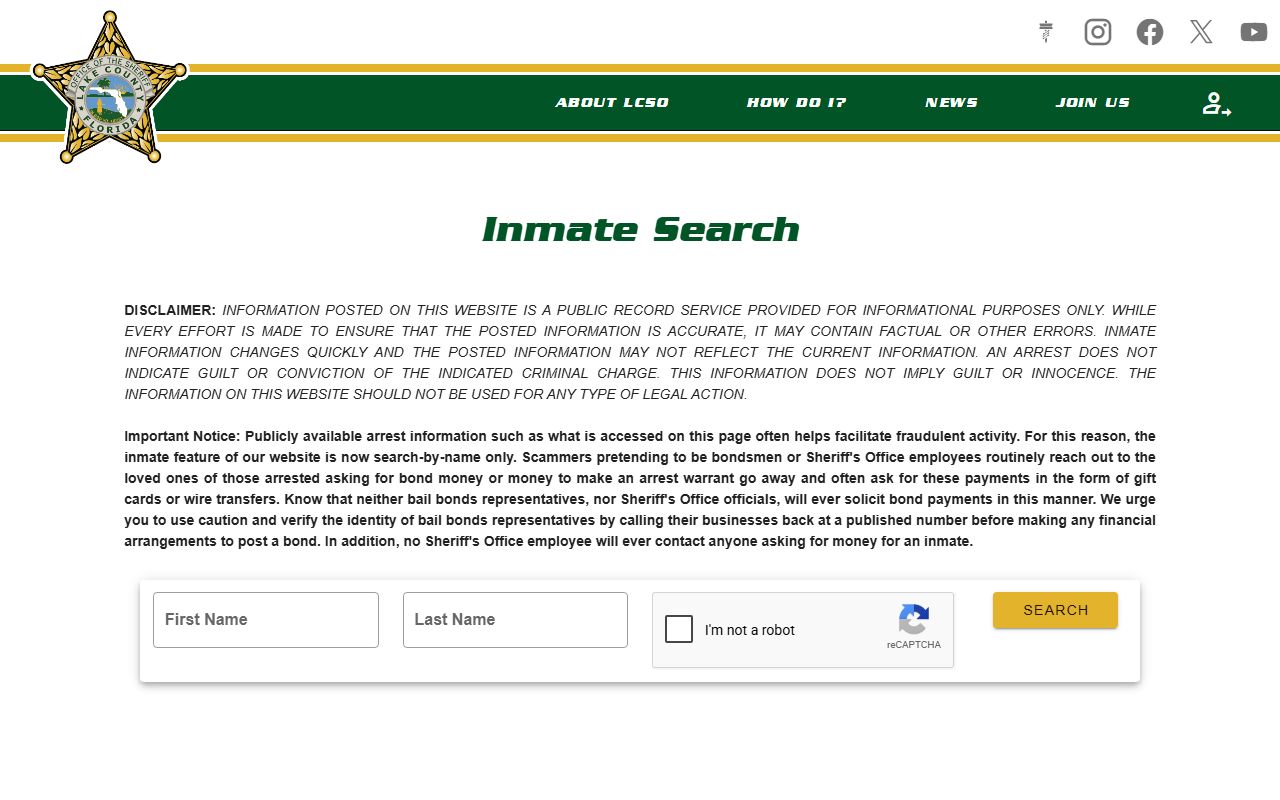
That same page is where the Sheriff posts the warning that families should read before they act on a phone call about bond.
Scam warning: The Sheriff's Office says no deputy or staff member will ever call asking for money for an inmate, and real bonding agents will not demand gift cards or wire transfers. Verify any bond caller by phoning the business back at a published number.
Current Inmate Lookup in Lake County
The roster covers people currently in the county jail system. The public form is short and strict, so it helps to know what each field expects before you search. The table below lists the visible fields on the Sheriff's inmate search.
| Field Label | Type | Required | Notes |
|---|---|---|---|
| First Name | Text | Yes | At least 1 character; letters, spaces, apostrophes, and hyphens only. |
| Last Name | Text | Yes | At least 3 characters; same allowed characters as first name. |
| reCAPTCHA | Checkbox widget | Yes | Must be cleared before a normal public search will run. |
| Search | Button | n/a | Shows a spinner while the roster is queried. |
A result list is only a short index. It shows first name, last name, arrest date, age, race, gender, a charge count, and a booking number. The full picture, including bond and photos, opens when you click the row. If nothing matches, the page shows a no-results message, which does not always mean the person is free.
What a Lake County Inmate Record Shows
The detailed profile behind a result is unusually full. It carries tracking numbers, up to three booking photo views, a physical description, arrest and booking details, and a charge-by-charge breakdown with bond. The table maps the main fields to what each one tells you.
| Field | What It Shows |
|---|---|
| Booking Number | The jail identifier for the current arrest or commitment. |
| Inmate Number | The person identifier used for the printable profile. |
| Photo Views | Left, front, and right booking images when available. |
| Physical Description | Date of birth, age, race, sex, eyes, hair, height, and weight. |
| Charges | Offense note, level, statute, bond amount, court room, court date, and case number. |
| Bond Totals | Total bond, amount paid, balance, or a no-bond status. |
A few fields people expect are missing on purpose. The public profile does not show the housing pod, a projected release date, or an attorney name. Those belong to the court case, not the jail snapshot. Some helpful terms are defined below.
- Booking
- The administrative entry into jail after arrest, with identity, charges, photos, and property.
- Pretrial
- Held before a conviction or sentence while charges are pending.
- Detainer
- A hold from another agency that can block release even if local bond is posted.
- No bond
- A custody status where at least one charge or hold has no release amount.
Past and Released Inmate Records
The county roster is built for current custody, so a released person can fall off it. The Sheriff's pages do not state exactly how long a released name or photo stays visible, and a new booking can change what shows. For booking or arrest records that are no longer online, the route is a public-records request to the LCSO Public Records Custodian, by email or phone. A sentenced person who has moved to prison will not be on the county roster at all and is found through the state locator instead.
Note: A no-result on the roster can mean a release, a transfer, a spelling mismatch, or a record held back under confidentiality rules, so confirm by phone before drawing a conclusion.
County Jail vs. State Prison: Where to Look
The single biggest mistake searchers make is using the wrong system. The county jail roster holds pretrial detainees and short-sentence inmates. Sentenced felons move to a Florida Department of Corrections prison, which has its own locator. The table below shows which system covers which part of the population.
| County Jail | State Prison (DOC) | |
|---|---|---|
| Who Is Held | Pretrial and short sentences | Sentenced felons |
| Run By | Lake County Sheriff's Office | Florida Department of Corrections |
| Where to Look | LCSO inmate search | FDC Offender Search |
| Stays Listed | While in county custody | Through the prison term, refreshed weekly |
If a person is sentenced and transferred, the county roster goes quiet while the state locator picks them up. A prisoner can briefly return to the county jail for a court date, which is why a state inmate sometimes appears in local custody for a short time.
State, Federal, and ICE Inmate Search
Three more locators cover the parts of the population the county roster cannot. The Florida Department of Corrections Offender Search covers sentenced state prisoners and state supervision, refreshed weekly with nightly release and location updates. The federal Bureau of Prisons locator covers federal inmates from 1982 forward. The ICE Online Detainee Locator covers people in immigration custody, though it cannot search for anyone under 18.
For custody alerts rather than a one-time lookup, Florida's VINELink sends notifications about custody and release events. A federal pretrial defendant may be held by the U.S. Marshals in a contract jail before the Bureau of Prisons shows them, so a federal search can come up empty even when a person is in federal custody.
Lake County Detention Facilities
Three official facilities make up the local custody map. The main jail holds the bulk of the population, a south-county site handles short-term intake, and one state prison sits within the county lines but answers to the state.
- Lake County Detention Center - The main county jail in Tavares, holding pretrial and short-sentence inmates.
- South Lake District Intake Facility - A short-term intake point in Clermont; no one is held there more than 12 hours.
- Lake Correctional Institution - A state prison in Clermont for sentenced adult male inmates, run by the state.
Lake County Inmate Population FAQ
How big is the Lake County inmate population?
The state's July 2024 County Detention Facilities report puts the Lake County jail average daily population at 824, against a rated capacity of 960. The Sheriff's own page lists an average of 828 tied to 2019, when the jail booked 9,169 people. Both are official snapshots from different months.
How do I search the Lake County inmate population?
Use the Sheriff's online inmate search. It is free, public, and searches by name only. Enter a first and last name, clear the reCAPTCHA, and open a result row for the full profile. There is no public way to browse every current inmate from that page.
Can I look up a released or past inmate?
The roster is built for current custody, so a released person may not appear. For older booking records, file a public-records request with the LCSO Public Records Custodian. A person sentenced to prison is found through the state locator, not the county roster.
What part of the population is pretrial?
About 73.9% of the Lake County jail population was pretrial in the July 2024 state report, with 527 felony and 82 misdemeanor pretrial inmates. Pretrial means held while a case is pending, before any conviction or sentence.